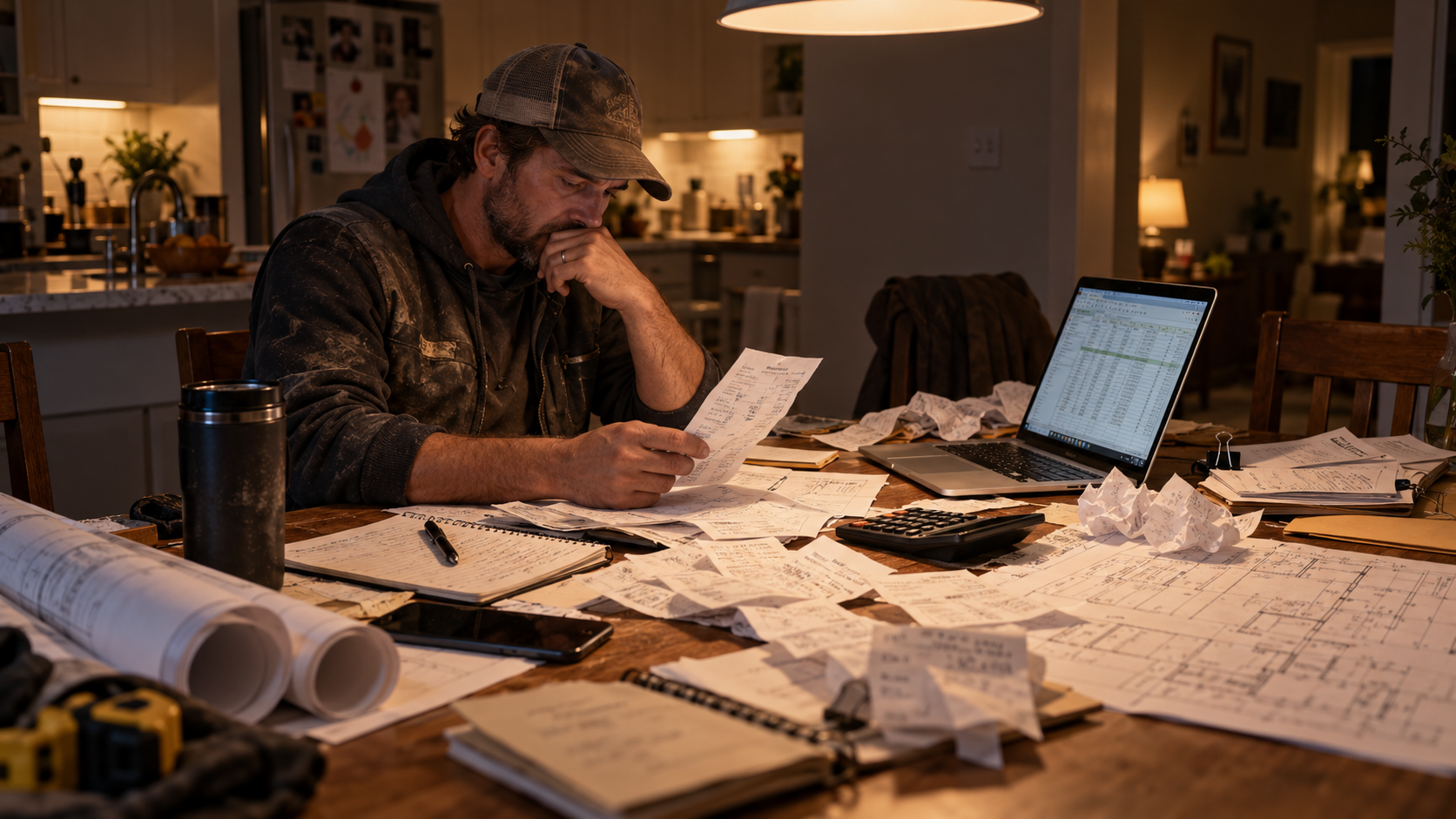
A construction business can have a full schedule, hardworking crews, and steady revenue—and still struggle to pay its bills.
The problem often starts with a gap between what happens on the job site and what shows up in the books. Materials get purchased before a customer pays a deposit. A change order gets approved by text but never makes it onto an invoice. A subcontractor’s bill arrives after the owner has already calculated the project’s profit.
For a small construction business, these gaps can turn profitable work into cash flow problems. Financial integration and regular reconciliation help close them.
Connecting the Job Site to the Books
Financial integration connects the tools used to run projects with the systems used to manage money. That might mean sharing information between estimating software, project management tools, time tracking, invoicing, and accounting.
Without those connections, the same information gets entered several times. Someone creates an estimate, copies the numbers into a project budget, prepares an invoice, and enters the transaction into the accounting system. Each handoff takes time and creates another opportunity for mistakes.
Connected systems reduce that repeated work and help keep records consistent. A material purchase can be assigned to the right project. Employee hours can flow into job costs. Approved changes can carry through to billing.
The goal is straightforward: make it easier to see how each project affects the business’s finances.
Busy Doesn’t Always Mean Profitable
Revenue tells you how much work you sold. Job costing helps you understand whether that work made money.
Consider a contractor who prices a renovation at $50,000 and budgets $40,000 in direct costs. The expected margin looks healthy. But extra labor, material deliveries, and a subcontractor invoice add another $6,000. If those costs sit in separate systems—or arrive late—the contractor may keep making decisions based on a $10,000 gross profit that has fallen to $4,000, before overhead.
When project and financial information stay connected, owners can compare estimated costs with actual costs while work is still underway.
That visibility helps answer practical questions:
- Are labor hours running ahead of the estimate?
- Have material purchases exceeded the budget?
- Did we bill for approved additional work?
- Does the next estimate need different pricing?
These answers are most useful while there is still time to act.
Integration Moves Information. Reconciliation Checks It.
Even connected systems need oversight.
Reconciliation is the process of comparing records, checking that they agree, and resolving differences. Bank reconciliation, for example, compares transactions in the books with the bank statement. A broader project review might compare supplier bills with recorded expenses or approved change orders with customer invoices.
These checks can uncover duplicate entries, missing expenses, payments assigned to the wrong invoice, or transactions charged to the wrong job.
An automatic sync can move information quickly, but it cannot guarantee that every entry is complete or correctly categorized. Regular reconciliation gives owners more confidence in the numbers they use.
Better Records Support Better Cash Flow Decisions
Construction businesses often pay for labor, materials, and subcontractors before collecting the full amount from customers. That timing makes cash flow especially important.
Accurate, current records help an owner see what has been collected, which invoices remain unpaid, and which bills are coming due. They also make it easier to distinguish money in the bank from money already needed for upcoming obligations.
For example, a large customer payment may make the bank balance look comfortable. But if supplier invoices and payroll costs have not been recorded, the available cash can appear greater than it really is.
Integration helps bring those obligations into view. Reconciliation helps confirm that the view is reliable.
Less Administrative Work, Fewer Loose Ends
In many small construction companies, the owner is also the estimator, project manager, salesperson, and payment collector. Bookkeeping often happens after hours.
Reducing duplicate data entry can free up time. Keeping records current also makes it easier to investigate a discrepancy while the details are still fresh.
A missing receipt from last week is usually easier to track down than one from six months ago. An unbilled change order is easier to resolve before the final invoice goes out.
Consistent habits prevent small loose ends from becoming a large cleanup project.
Start With a Simple Routine
Improving financial visibility does not require replacing every tool at once. Start with the places where information is most often delayed, lost, or entered twice.
A useful starting routine is to:
- Assign income and expenses to consistent project names or job numbers.
- Record purchases and collect receipts promptly.
- Track approved change orders through to invoicing.
- Review unpaid customer invoices and upcoming bills each week.
- Reconcile bank and credit card accounts monthly.
- Compare estimated and actual job costs during the project and after completion.
When choosing integrations, check which information transfers, how often it updates, and how errors are flagged. A connection is most useful when someone understands how to review it.
Build Confidence in Every Job
Small construction businesses make financial decisions every day: whether to take another project, hire help, purchase equipment, or adjust pricing.
Those decisions become easier when project activity and financial records tell a consistent story. Integration helps information reach the right place. Reconciliation helps confirm it is accurate.
Together, they give owners a clearer understanding of what each job earns, what the business owes, and what cash is available to keep work moving.