
The AI-native job ledger for construction.
Every other system asks you to work its way. Pointload adapts to you. We pick up your cost data wherever it already lives and post every hour and every dollar spent to the job it belongs to.
From days to hours
Time from job completion to invoice sent. from days to hours
Nothing to rip out
Your accounting, payroll and field apps stay where they are
Zero crew training
The field keeps texting, photographing, and using the apps they're used to
Software used to mean changing how you work.
It doesn't any more.
Construction software was built to a rigid blueprint, so every contractor had to be reshaped to fit it. That is why implementations run for months and why the crew never adopts it. An AI-native ledger reads what you already produce, in the form you already produce it.
What it takes to switch

-
 Their workflow. Their rules.
 Your business, not a template.Your cost codes, job names, and rates.
-
Months before the first job is costedBuilt around your real jobs.Historical jobs set the foundation—not a blank template.
-
Another login the field won’t useNo change for the crew.Text, photo, voice, paper. Keep working the same way.
-
The office retypes what doesn’t fitRead, not retyped.Handwriting, PDFs, and messages become usable information.
-
Replace systems you already knowYour stack stays.Pointload reads from your tools and writes back to them.


We pick the data up wherever it already is.
No new app for the crew. No forms. Whatever your people already send, Pointload reads and posts. Pointload suggests; you approve. Anything below confidence waits in a review queue. Nothing posts to your books and no invoice leaves without a person saying so.
Crew photos, hours and change orders agreed in a group chat
Text message
Hours texted to the office, exactly as they are today
RBM
Our own verified sender, so the field replies in their phone messages app
Photos of paper
Handwritten timecards, tailgate notes, delivery tickets, receipts
Vendor receipts via email or Bill.com
Supplier invoices and statements, including several bills in one file
Voice
A spoken daily report, in English or Spanish
 Pointload
Bill time and material
faster. Know the margin
on the bid work sooner.
Invoice in hours, not days.
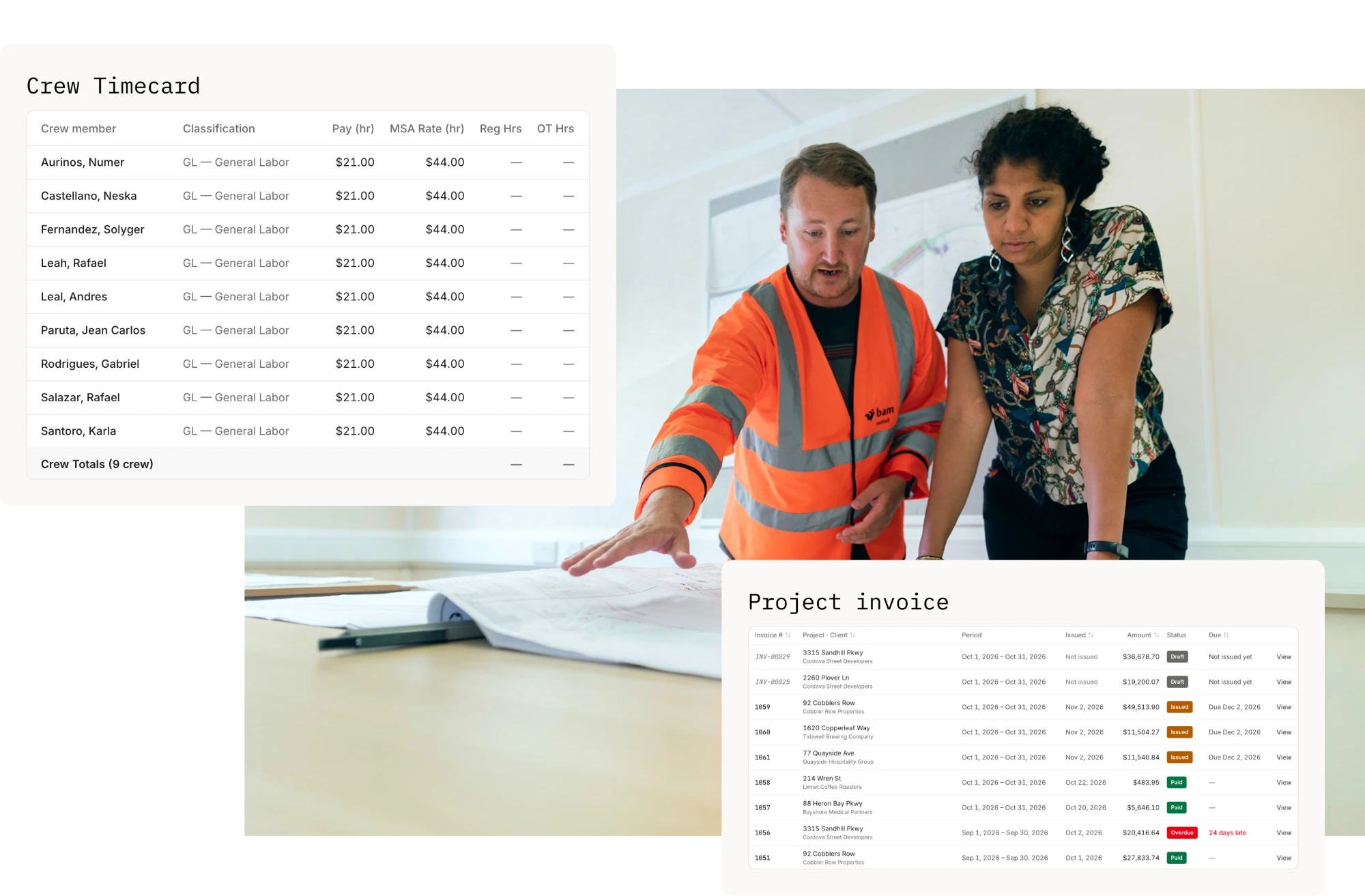
T&M work is lost in the gap between the field and the office. Hours sit in a phone, materials sit in a pile of tickets, and the invoice waits until someone reconstructs the week.
- 01Hours arrive by text, photo, app or voice as the shift ends
- 02Vendor invoices attach themselves to the same job
- 03The invoice assembles with the backup already attached
- 04You review and send it directly or through your own accounting system
Cost against budget, while the job is still running.
On fixed-price work the number that matters is cost against the estimate you bid. Pointload ingests the original detailed estimate from your takeoff, then holds every posted cost and every daily report against it.
Linking the estimate to daily progress is what turns a cost report into a real schedule of work in progress, and what surfaces an overrun while you can still do something about it.

We connect to what
you already run.
Pointload is a ledger, not a replacement for your accounting, your payroll or your field apps. We read from them and write back to them. Running something else? The whole point of being AI-native is that we do not need your data in one prescribed shape. Tell us what you use.

Bill.com
Vendor invoices pulled with their PDFs, multi-invoice files split

ServiceTitan
Jobs, calls and field activity read in place

QuickBooks
Invoices sent from your own books, on your own template

Time card apps
Shifts and notes, with the real job matched from the note

Email & PDF
Forward to a Pointload address, or let us watch an inbox

WhatsApp, SMS, photo messaging
The channels your crews already use, no new app

The bulk of the work is already done. To go look at it, and approve it, and make sure that it's assigned to the correct job, that's, like, so easy.Office manager, family-owned trade contractor, San Francisco Bay Area
Everything [I’ve used before] is built very generic… built for you to have to adapt your company to their platform. This is by far superior.Product manager, mid-size commercial builder, multi-state
See it run on one of your own jobs.
Send us a finished job exactly as it exists today: the estimate, the time cards, the vendor invoices, in whatever form they are in. We will build the ledger from it and show you the margin.